Blog

  • A Perfectionist?  Who?  Me?

    A Perfectionist? Who? Me?

    This morning I began to analyze a behavior I’ve had for years while working my morning puzzles.  I like the letters on the crosswords to be the same size and shape.  If one is not, I erase it and “correct” it, as if it were wrong.  With Sudoku, I like the numbers I put in the squares to be the same size as the numbers already printed—and the same distance above the line.  How very Monkish of me!  (Monk is the fictional obsessive/compulsive defective detective on TV.)

    Crosswords have been a long-time love for this wordsmith, and I added Sudoku after a major surgery in May 2006 when my brain didn’t seem to want to come back online.  I started doing both crosswords and Sudoku every morning in order to develop the new synapses that researchers said would help keep me from a complete brain warp.  (I’ll let you know how that’s working in a few years.☺)

    I’ve never thought of myself as a perfectionist.  I like things the way I like them (don’t we all?), but they don’t need to consistently meet too high a standard.  Anyone who knows me knows my house is never too clean, my ironing never quite done, my dryer frequently full of clothes that have been there for a few days.  Toward the afternoon, one can often find a pile of dirty breakfast and lunch dishes in my sink.

    However, if this insistence that all my crossword and Sudoku puzzles be uniform isn’t perfectionism, I don’t know what is!  Today, I finally asked myself “Why????”  The answer was directly in front of me—perfectionism that is rooted in fear.

    I’ve been aware of an underlying fear each time I pick up a pencil or pen or sit in front of my computer and each time I enter my office to write.  I’ve been aware of the memories of the abuse in my early childhood when I was beaten for trying to learn to write with a pencil.  (I suspect my abusers were afraid I would tell, which I certainly did!)    This spilled over into my professional writing.  I have also been afraid that I wasn’t “good enough” to be a writer or perhaps couldn’t do it at all.  (I understand a lot of authors have to overcome this one daily.)

    A friend of mine once asked me how I perceived being an author.  I immediately said,  “It’s like having a playground on the other side of a high fence, and I often don’t know how to get over it.”  The fence is fear, which keeps me from writing—at least temporarily.   And the way I keep myself afraid is perfectionism.  Each day when I open my office doors, I am challenged to get beyond the fear, to sit myself down and write for my scheduled amount of time, no matter how I feel.

    A perfectionist?  Me?  Yep, I guess so—at least when it comes to picking up a pencil or pen, pecking on a computer or doing word games.  Can I overcome the downward pressure rooted in my childhood—or the pressure I place on myself because of expectations and fear I allow to color my present?  I haven’t got a clue, but you can be sure I’m going to try.  And this effort to reach out and share my dilemma is a good beginning.  When I get to the point that I don’t care how big the numbers and letters are in crosswords and Sudoku, and when I no longer think about whether I am good enough as a writer, I will know I am firmly on the path to overcoming my own brand of perfectionism. ☺

  • Love (and Loss) on Valentine’s Day

    Love (and Loss) on Valentine’s Day

    Valentine’s Day—a wonderful celebration for some. A day to get through—to get over—for others.  But no matter your present situation, if you have had love in your life—even lost love—it has changed you, hopefully expanded your heart, given you an even greater capacity for love.

    I first wrote this poem in 1969.  I was 21 years old.  I have “dinked” with it over the years, adding the perspective of time.  But the message is basically intact.  It speaks for itself.  I hope it helps my readers to understand that we not only need to be loved, but we also need to love others.  And each time we do, our hearts expand, making room for more love.


    Time and Loss

    Reflecting back,
    I watch time and distance recede,
    shrinking mountains
    into smooth, rolling hills
    against a brilliant sky.
    Like the leveling peaks,
    pain and loss recedes,
    releasing my mind,
    quieting that place in my heart
    reserved for you and you alone.
    Not saying that I’ll never love again,
    nor that another cannot enter in.
    But time can never take the past away.
    It cannot make the feelings felt,
    the laughter heard, the seasons shared
    pass into moments never lived,
    nor keep this heart
    from loving moments given.
    For I know in life there will always be
    a time when there was only
    you and me.

    Copyright:  Laurel Jean Becker February 13, 2014

  • January Rewind

    January Rewind

    As I struggle to release the lovely chaos of Christmas while boxing the ornaments, Christmas miniatures, hearth greens, Santa collection and Christmas crèche, I take a deep breath and inhale the stillness of this cold, quiet January morning.

    There was a time—when our children lived under our roof—when I dreaded the “let down” of January.  I missed the hustle and bustle of shopping or crafting the just-right gifts for family and friends, the smell of baked goods to be shared with long-loved neighbors, unboxing the Christmas décor with the accompanying “oohs” and “aahs” from the children, and my husband and I taking them to ski the Colorado mountains.  I also missed the bright wrapping on presents under the tree, the anticipation and excitement of our son and daughters, who were hoping-beyond-hope they would be gifted that certain item topping their wish list, the days when the house bulged with laughter of late-rising, school-freed children.

    In those days, I braced myself against the quiet of January when the children went back to school, my husband returned to work and I was left alone with my annual January letdown.

    As I’ve reached my late-middle age, January has taken on a new significance.  I no longer designate it, along with February, as a month to be gracefully tolerated until the crocuses popping through the spring snows in my garden re-color my life.

    January is now welcomed as a time for reflection, easy weekends with my husband and lunches with friends who have also come to appreciate the less-rushed time together that January offers.  In place of after-Christmas letdown, I now take time to enjoy a hot cup of tea and a good book while curled up under my tartan coverlet, a gift from my husband, or consider in pleasant anticipation new places to travel when I can welcome warmer weather.  I prepare oven meals that not only please our palates but also add warmth and aroma to the whole house. Everyday chores—washing, mending, organizing and running errands—are now accomplished at a slower, easier pace, giving my life the sense of quiet rhythm, routine and comfort I need when the temperature dips to frigid levels. How fortunate I am to have a home that embraces me with love and keeps me warm and safe.

    I’m not the first to find January (and February) “less than” months.  In fact, the original Roman calendar consisted of ten months (304 days)—winter being considered a month-less period.  Around 713 BC, January and February were added, allowing the calendar to equal a standard lunar year of 364 days—evidently an afterthought even by the ancients.  Just as it did in those times, January finally takes its rightful place in my life—equal in importance to the renewing springs, playful summers and colorful falls.

  • Celebrate!

    Celebrate!

    It’s that time of year again.  Lots of decisions to make.  What gifts to purchase?  What to serve for Christmas dinner?  When to decorate the house? Where I am generally not a people pleaser, at Christmas I tend in that direction.  To keep myself balanced, every year I make a decision to find something I can do to please myself.

    Christmas means different things to different people, some purely secular:  giving (and receiving) graciously, parties, helping those who have less, spending time with family and friends and remembering those loved ones who are now gone.  While remembering brings occasional sadness, it also generates gratitude for having had those people in my life in the first place.  I love Christmas glitz:  houses flooded in lights, presents under the trees—even artificial trees, Christmas music piped through store loudspeakers, motorized Santas waving to children in shopping carts who are exclaiming, “Mommy, look at all the toys!”  And while many complain about cranky shoppers, my experience is that people are friendlier at Christmas—willing to smile and give a “Merry Christmas” or “Happy Holidays” greeting.

    I am a Christian, and for me Christmas has both a secular and a spiritual meaning.  I’ve often heard from pulpits that Christians celebrate the day that “Jesus came to earth to save us from our sins.”  This statement, though true, has never been my focus.  I don’t dwell much on sin–especially at Christmas.  There are those who might say I should. 🙂 It feels like a bit of a “Debbie Downer.”  Christmas is a time when I celebrate that God did not abandon me to this crazy world.  Rather, He sent Jesus to show me how loved and cared for I am and how to care for others.  Matthew 22:37-40 says, “Love the Lord your God with all you heart . . . soul . . . and mind,” and “Love your neighbor as yourself.”  I celebrate His lesson of love this time of year.

    God’s Love is not all I celebrate.  I celebrate the purpose His coming gave my life.  I’m not an evangelical type; it is not my gift.  I knew that when I was twelve.  Our church/school instigated a door-to-door campaign to invite people to worship.  They wanted the school children to participate.  I declined to do so.  (Not a popular decision.)   I told God (yes “told”) if he wanted me to speak His message, He would have to bring the listener to me.  I wasn’t chasing after anybody!  Funny thing is, there have been many over the years who asked me questions regarding my faith (and presented the opportunity to speak). I know my purpose is to fulfill His will for my life, to do His work as a small cog in a big wheel, to be a good wife and mother, to use the gifts He has granted me—hopefully, one of those being a writer—in responsible ways.

    I celebrate the family I have.  I celebrate the opportunity to give and receive–and to remember those who have less.  I celebrate “glitz.”  I celebrate His coming—that He did not abandon me here, which means so much to this abandoned child.  I celebrate that God is love—and He wants me to know it.  And I celebrate His purpose in my living.  That is a great deal of celebrating, and I am grateful for yet another opportunity to do so.

  • Collision!

    Collision!

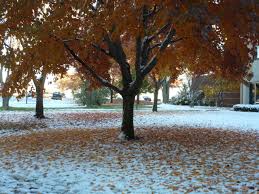
    One morning last week I woke to a light dusting of snow—maybe two inches.  There is something odd about snow resting on yet-green grass and stubbornly clinging to bright yellow- and rust-colored leaves.  Two seasons collided in my yard, and although beautiful, it just didn’t seem right.  But nature, as it is, does her own thing, and she certainly doesn’t ask my permission.

    When I was a child, I wanted fall to “get a move on” so that Thanksgiving, my favorite foodie holiday,  and Christmas, with all the excitement of presents, would come quickly.  (Yes, I knew it was about being thankful and celebrating Christ’s coming, but after all, I was just a kid!)   But now I don’t want winter to come too soon.

    Over the years, I have come to appreciate fall in ways I never did in my youth.  The colors have always been beautiful; but now I identify with fall.  The spring and summer of my life—attending school, anticipating first dates, beginning a new life with my husband, raising my three babies—are all behind me.  Now, in the fall of my life, I can at last give myself permission to slow down, to enjoy my first cup of morning coffee and write in my journal while my husband quietly sits across from me focused on the morning paper.  I like his quiet presence.

    Now he and I have time to engage in long, thoughtful conversations—though admittedly, they can get a bit lively as we discover we don’t think exactly alike.  (We never did, but he is becoming increasingly aware of that as I become more vocal about my ideas.)  Still, the process is enriching.

    In the fall of my life, I can choose those activities that will truly bring me happiness:  enjoying my delightful grandchildren, basking in my relationships with my grown children and their mates, having time to write and spending time with my author friends and thinking about trips I may want to take or adventures I’ve not yet experienced.  In other words, I get to investigate what I want on my personal “bucket list.”

    I am, however, at a very tender age.   I’m fully aware that at any time the Grim Reaper could kick over my bucket and spill its contents into eternity.  Most of the time I remain in comfortable denial and think I have tons of time left.  However, I was reminded of my vulnerability when I attended the funeral of a close friend whose fall and winter collided before she could begin to get to her bucket list.

    As I look out at snow clinging to exploding, yellow leaves, I am hopeful that my winter can be staved off a bit longer, that God grants me time to enjoy fall’s metaphorical colors and that there not be an immediate fall/winter collision in my life.  But heck, neither nature nor God will ask my permission.

  • Infinity Park

    Infinity Park

    A recent dream gave me insight into my feelings of uncertainty as my husband and I near our retirement with questions about sufficient savings, Medicare changes and Social Security.

    In my dream, I was standing next to two large pillars supporting an arch with the name “Infinity Park” in wrought iron script across the top.  One would think, by the name, this park to be unending—or that one was trapped in it, like in the Eagles song, “Hotel California,” where you can check out, but you can never leave.

    I could view the outline of a few large, nearby trees with leaves that moved with a fresh breeze. Thick, green grass cushioned my feet and I knew, intuitively, that the park was beautiful.  I also immediately realized that Infinity Park was a place full of future choices.  I couldn’t see them because it was dark.

    I was curious, wanting to view everything the park contained.   Wouldn’t it be great to see all my future options?  Wouldn’t I feel less vulnerable to the whims of life if I already knew my next choices and how they would work out?  Absolutely!

    I woke up and my mind suddenly riveted on an experience I had while shopping for a baby shower gift.  I stood, overwhelmed, for 30 minutes in the baby bottle aisle of an infant store where an entire row was dedicated to scads of bottle styles, each claiming theirs the superior design.  I felt that if I didn’t choose the right bottle, this poor kid was doomed to terrible ramifications. I walked away because it was too hard to figure out which was best.  I have since read in psychological studies that too many choices tend to paralyze people.  I felt comforted (and less foolish) when I realized I was not alone in my indecisiveness.

    Now I understand why, in my dream, I couldn’t see deep into Infinity Park.  It is in my best interest to find one choice at a time and either embrace or reject it before going on to the next.  If I were to see the park lit up, exposing all my future choices, I could not take another step forward.

    Infinity Park held much to be explored, and I have a sense that the process will extend into my own infinity.   A happy, fulfilling retirement is meant to be lived one day and one choice at a time.  My dream about Infinity Park reminded me I could do so with confidence in my process and in the outcome.

  • Controlling Jack

    Controlling Jack

    A professional writer is an amateur who didn’t quit.
    — Richard Bach

    I once spoke of writing as my “hobby,” but years ago I made a decision to consider myself a professional writer. I ordered letterhead, joined two writers’ organizations, and set aside three hours each day for uninterrupted writing. Three hours is a long time to glue my seat to a chair while knowing full well the world probably wouldn’t soon see any results.

    My present project is a poem entitled, “Jack in the Box.” “Jack” has a mind of his own and pops on his time–not mine. I plan to submit the poem today.

    However, first I have clothes to wash and dishes to get in the dishwasher.
    I finish the dishes and put another load of clothes in the washer. The washing machine chugs while my phone rings in my office. I won’t allow the machine to take a message. The ringing phone is like a crying child I must pick up. It’s my automatic response retained from when my kids were young and called when they became sick at school or, as teenagers, needed help. The call is from my accountant, who reminds me that our yearlong tax plan will go up in smoke if I fail to meet the deadline.

    I begin preparing a grocery list instead of writing so I can avoid the nervous feeling when I pick up my pen. Is the nervousness really unacknowledged fear? Fear of failure? Rejection? Success? I am uncertain. Fear is a paralyzing force. You needn’t listen to it anymore, I repeat over and over to myself, hoping that it will sink to the bottom of my writing well.

    A few years after I decided to be a professional, I added an office to our home. Oak, crown molding frames the peach colored walls of my study. Floor-to-ceiling oak cabinets and bookshelves embrace my most beloved books. Despite the room’s inviting warmth, I don’t feel ready to work.

    In her essay entitled, “Professions for Women,” Virginia Woolf referred to her alter ego as her “Angel in the House.” Rather than sympathize with her own wishes to write, her Angel preferred to sympathize with the wishes of others. Like Virginia Woolf, I too have an “Angel” who is overly sympathetic, unselfish and sacrificial. But Woolf’s Angel represented the traditional roles of women of 1931–mine is just an excuse. She stands at my study doors, like the angel on the East Side of Eden, waiting for me to try and enter. And just as I cross the threshold, she whispers, “Tonight’s dinner isn’t fixed,” or “The garden needs weeding,” or “Those library books are overdue.”

    This time my Angel whispers, “You need some groceries.” And I do. I quickly grab my purse and head out the door. After the groceries have been put away, my poem, “Jack in the Box,” tumbles in the back of my head like clothes in the dryer. At least for today, Jack and I are the same person. It’s me I can’t control. I spent three quarters of my day proving that fact.

    I fix a cup of herbal tea. It motivates me to close the French doors to my study and turn on the computer, a baby step in the right direction.

    Once I begin, the time flies, and I wonder why I hesitated. Two hours later, I seal the envelope. I started this poem several months ago, working on it daily for the past three weeks. On the way to the mailbox my shoes shuffle on the sidewalk the way they did when I was a kid and my mom forced me to do unwanted chores. I picture our mailman shaking his head at my efforts to get published and wondering when I am going to get off my duff and get a real job–like his. I turn the envelope upside down, hoping he’ll toss it in the “out” basket without looking at the address.

    With my poem in the mail, I begin the first draft of a requested article. This time I don’t listen to my Angel or make excuses to cover my fear. The washing will get done eventually, the children are grown and the phone is not a crying child. My nest is empty. The kids are marvelously independent and accomplished.

    The alarm clock jars my attention away from the paper. I open my French doors. I am committed to three hours of work per day, but no more–that’s my rule. I congratulate myself. Three hours done! Smug satisfaction invades my mind as the hall mirror catches my image, and I can see a glow on my face. Yep, I assure myself. A little self-discipline is all it takes.

    (Previously published in Authorship by The National Writer’s Association
    Winter/Spring, 2003, No. 245)

  • My Unfinished House

    My Unfinished House

    I dreamed the other night that I was walking with a man dressed in bib overalls.  He was my father—who has been dead 55 years.  My father is showing me the house he built.  The site is beautiful, and I am happy for that.  The house is on a rise overlooking a valley.  He is proud of his accomplishment and is obviously hopeful that I will appreciate it.

    My father leads me to the door, opens it, and allows me to enter first.  The house is unfinished.  There is no floor, which is out of construction order—just a well-swept hard ground.  The roof is on, but only studs form the frame.  There is no plumbing and no designated rooms—simply one large, unpartitioned space.

    My father calmly closes the door, and for a moment I feel frightened, trapped.   I lived most of my childhood in fear of having no escape.  Suddenly I realize that it is strange for my father to close the door because I can walk between the studs and out of the house.  My father seems unaware of this fact.  With this understanding, I relax and I awaken.

    This dream has plagued me all day.  I tried to shove it out of my thoughts, to focus on work around the house, to shop, to prepare my meals.  But no matter how I tried, it relentlessly pushed itself back into my mind, accompanied by the questions:  What does it mean?  And what am I trying to tell myself that is pertinent to the present?

    This evening, it occurred to me that in my dream my father thought his job was finished; however, it obviously wasn’t.  Nevertheless, he wanted me to like it.

    I’ve spent much of my life finishing this house myself.  First, I’ve put the floor of faith beneath my feet.  As a youth, I attended many church services with my friends where they had altar calls for those who wished to commit their lives to God.  Each time, I answered the call.  Once should be enough—but for me it wasn’t.  A kind, loving God who cared about me was not the example given to me in my childhood.  Trust felt impossible.  However, over many years, I have gained trust in God by turning the corners I knew He wanted me to turn.   As a result, I experienced unexpected joy and the blessings He had for my path in life.

    I’ve installed the emotional plumbing and kept the integrated memories and emotions flowing into my present.  I valued all emotions—both from myself and those around me.  I gained understanding of and appreciation for my extremely intuitive nature and listened carefully for the voice of my writing muse.

    I’ve finished the framing with boundaries.  This was not a skill taught in my family.  However, early on I learned where I left off and others began, emphasized understanding self before others, kept my mind focused on my own issues, responsibilities and goals. I built internal walls and rooms that separated my calling from my work, my parenting from my care of self, my husband’s and friends’ needs from my own.

    Finally, I furnished my home. I had fun with the children and my husband, enjoyment of friends and participation in their lives—both good and bad.  Within each room, my calling, my work, my parenting, my relationships, I found places to rest, to find quiet time, to journal.  I furnished my life with hobbies like reading and sewing.  I learned to exercise routinely.  Self care became important.  The furnishing has been the fun part.

    My father died young—in his 30’s.  He had no time to mature into a fully-grounded human being.  He died too soon.  Had he lived, I would like to think I would have had a better start, more support, more love, and even a finished floor beneath me.  But from what I know of him—plus what the dream revealed—I am not sure he knew to do more.  What I received was a blueprint—something I could build on.  It was up to me to finish this house—my spiritual walk, my physical abilities, my emotional maturity.  The unfinished house was all my father could do.  But he did leave me with a sense that someone cared for my well being and with an understanding that, as his daughter, I was important to him—that he would want me to be pleased.

    Now that my children are raised, I hope they will feel I have given them a good beginning home with a floor of faith, healthy boundaries, a flow of accepted emotions, rooms of their own, and confidence in a solid roof of love that can support them while they attempt to do the same for their children.


  • First Santa

    First Santa

    At the beginning of every Christmas season, my emotions go through a roller coaster process that leaves me a bit shaken. As it is with so many others, my early memories of Christmas have been—painful. I know I am not alone. I know there are many who can identify.

    The process starts when I don’t want to put away my fall decorations: the pumpkins, miniature bales of hay, faux brightly-colored leaves, the basket of gourds on my dining room table, the linen tablecloth.  My mind fills with oodles of excuses to put it off: they are beautiful; I haven’t had sufficient time to enjoy them; the work of putting them away is daunting, etc., etc. My favorite season of the year, fall becomes even more cherished just before I make room for the Christmas decorations.  Getting started feels like I am trying to run a race with lead weights in my shoes and inflexible knees that refuse to cooperate.

    This is year was no different.  After being inspired by my industrious sister-in-law, who has already dispatched her favorite fall things and is ready to set out her Christmas ornaments, I was determined to spend today keeping a timetable other than my own.  I should have known.  That never works.

    So, today was spent regrouping my wayward emotions, trying several times to get started, and finally giving up.  My husband and I watched Russell Crowe in Robin Hood.  It was terrific entertainment—although the PG-13 rating is questionable.  But the movie did the job: it took my mind off decorations, both fall and Christmas, and freed me from trying.  It is only when I stopped striving and listened to my own voice that I was able to regroup enough to define the problem yet again:  I hesitate to enter this holy season because it reminds me of injurious memories.  Or perhaps I am tired of trying to forget.  Either way, it is a real drag—literally.

    Tonight, I am ready to remember good things:  my children’s excitement on Christmas morning; the baked breads, candy, cookies that I disburse each year to friends and neighbors who accept them with big smiles; carefully chosen gifts under the tree.  Finally, I remember a poem entitled, “First Santa.” I wrote it years ago to honor a man who tried to divert a little girl’s sad heart—and succeeded.  It is this recollection that helps me to give myself what he gave me: a distraction from loss.  In the midst of a painful childhood, because of the kindness of one person, I was thrown a lifesaver that I could hold onto through all these years: the memory of what it felt like to have received love and care on one sad Christmas morning.

    Along with the nativity scenes, snowmen, Christmas tree, each year I put out my Santa collection. It reminds me that I still want to be like my first Santa.  I want to bring a little joy into a world that suffers under the burden of too much loss.

    I now can take time to remember, time to allow myself to feel, to reread “First Santa.”  Soon I will get the decorations out.  I will attempt to be a small part of a good memory—for myself and others.

    First Santa

    Naked windows outlined the black night.
    A dim ceiling light abandoned
    the shadows in the corners of the room.
    The sparse Christmas tree,
    too close to the pot-belly stove,
    wore needles slightly browned
    and withered on one side.
    Red and green paper chains bound the tree
    and our hearts.
    Artie came through the front door.
    A false white beard betrayed his face.
    His red balloon-like vastness packed the room.
    I thought he might explode.
    A cavernous bag slipped from his shoulder,
    landed near me, and unfolded.
    Big enough to hold me, to carry me out the door.
    I slipped behind the wooden rocker.
    Artie’s rough hands, carved by the lumber mill,
    searched the bag for toys.
    A thunderous Ho Ho Ho accompanied each gift.
    I got the dolly I saw at Monkeygoin’ Wards,
    the one kept on the highest shelf,
    a place where a kid couldn’t reach.
    My dolly came dressed in red and black plaid,
    with lace-edged panties and patent leather shoes.
    Her plastic hair and painted smile drew my eyes
    from the empty chair at the table, and my thoughts
    from the freshly turned plot just up the hill.
    That was my fifth year, the year I learned
    that daddies die,
    and that Santas named Artie try to take their places.

    Laurel Jean Becker
    ByLine Magazine – Honorable Mention, 1999
    National Writer’s Association – Honorable Mention 2004