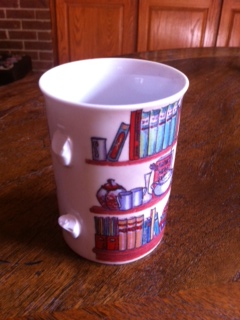
On my way to meet with my writing group, I grabbed my favorite travel mug—the one with a broken handle. The picture of a skull with a broken jaw immediately popped into mind. Oh yeah I thought and began laughing. I’m working on a murder mystery, and there’s no telling where the mind will travel when it’s cooking a mystery.
Back to the broken mug. It’s the one with pictures of bookshelves on it. I love the warm color of the books wrapped around it and the way it feels in my hand—tall, narrow and lightweight—easy to hold. A thoughtful friend bought it for me, and I liked it so much I immediately went out and bought three more. Over the years, only two have survived—one minus a handle.
Which brings me to the point. Broken can sometimes be a useful state. What makes my broken mug better? Without the handle, it fits in my car’s cup holder. As I drove across town, I continued to mull over the cup and the metaphorical usefulness of being broken.
Practically everyone I’ve known has suffered tremendous loss: death of children, spouses, parents; divorce; loss of jobs, homes and security; and ill health. Let’s face it, life is full of potential for loss, and by the time we’re older most of us have accumulated a considerable amount. God does not cause the pain in this world. Life does. However, as with my useful mug, God can engage our broken hearts constructively—to help others, to teach us, to help us understand our need for Him. II Corinthians 12:9 reminds us: “My grace is sufficient for you, for my power is made perfect in weakness.”
My first heartbreak came in childhood, but I’ve had a few since then, too. Sometimes I’m grateful for brokenness—but not all the time. If I am occasionally inclined to wail, “Why me?” I remember what I learned from a friend and remind myself, “Why NOT me?” I don’t know anyone who hasn’t suffered events that left them broken (and sometimes bitter)—at least for a while. Hearts can become bitter or hardened if we’re not careful. Someone once told me that hardening of the heart could age people more quickly than hardening of the arteries. I’m not sure if that’s true, but it’s an interesting idea. We must work to keep our hearts open by dealing with our brokenness, and the emotional fallout, using a constructive, healthy approach. Still, wouldn’t most of us rather be 100% whole all of the time? I know I would!
Though life can be difficult and painful at times, purpose and growth can be found in the pain, and much resilience and perseverance in carrying on. Plus, there is gratitude for the broken mug—and broken heart—that sometimes is a better fit. Just like my broken mug fits better in my car’s holder, I know my broken heart fits better into the human community and my Life Holder’s plan.


Leave a Reply